
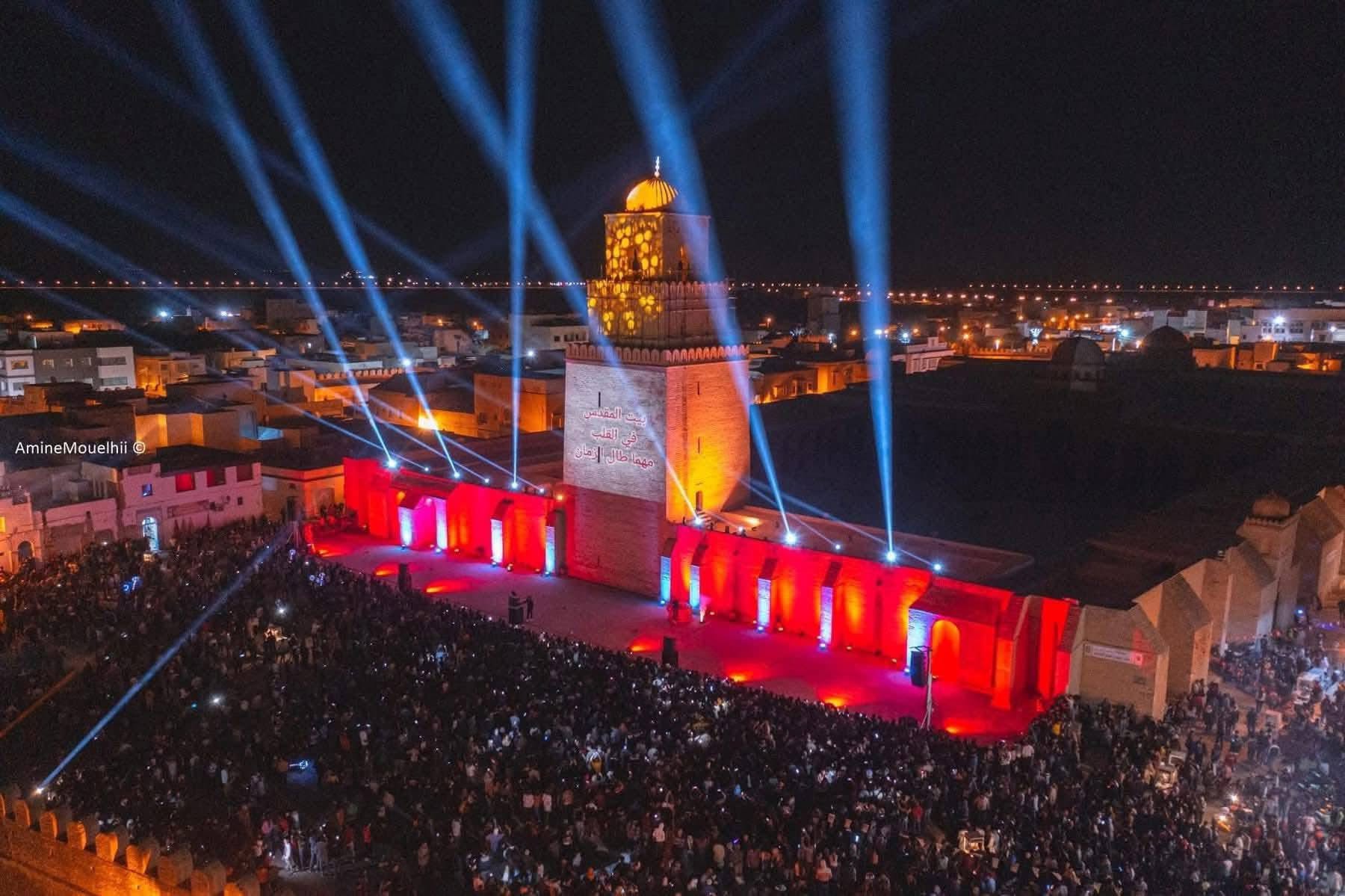
The night before Mouled, two sounds travel through Tunisia at once. In a kitchen in Tunis, a wooden spoon scrapes the bottom of a heavy pot as a grayish-brown cream thickens over a low flame — the zgougou, finally ready after an afternoon of soaking and sieving. And two hundred kilometres south, in the medina of Kairouan, a drum starts up in a narrow alley, then another, until the whole walled city seems to keep one slow, insistent beat. One sound is private and the other is public, but they belong to the same evening. This is how a country marks the birth of its Prophet: with something sweet set out for the neighbours, and something loud carried through the streets.
Mouled is among the most beloved dates on the Tunisian calendar, and one of the least understood by visitors — partly because it never lands on the same day twice. Here is what it is, where to feel it most, and why no Tunisian household considers it complete without a particular bowl on the table.
What Mouled Is — and Why the Date Keeps Moving
Mouled — mawlid an-nabawi in classical Arabic, shortened to Mouled in Tunisian dialect — commemorates the birth of the Prophet Muhammad. It falls on the 12th of Rabi al-Awwal, the third month of the Islamic lunar calendar, which in 2026 corresponds to around 24–26 August, with the exact day confirmed by the sighting of the moon. Because the lunar year runs about eleven days shorter than the Gregorian one, the holiday drifts steadily earlier each year — the same quiet migration that moves Ramadan and Eid al-Adha across the seasons. A few decades ago Mouled fell in autumn; in 2026 it arrives at the tail end of summer.
It is a public holiday — schools and most businesses close — and it is observed across the Muslim world, but the scale of celebration varies enormously from country to country. In North Africa, Egypt stages the largest festivities; Tunisia is a close second. For a small country, that is no small claim, and it is anchored almost entirely in one city.
Kairouan, the City That Becomes the Festival
If Mouled has a capital, it is Kairouan. Founded in 670 CE, it is often called Islam’s fourth holiest city — “the Fourth of the Three,” as the half-joking line goes, after Mecca, Medina and Jerusalem — and it carries that weight openly. For the days around Mouled, the medina stops being a town and becomes something closer to a single enormous gathering: part pilgrimage, part market, part open-air concert. In recent years the city has drawn close to a million visitors over the festival, arriving from every region of Tunisia and from neighbouring countries.
The gravitational centre is the Zaouia of Sidi Sahib, the shrine Europeans nicknamed the Mosque of the Barber. It holds the tomb of Abu Zama’a al-Balawi, a companion of the Prophet who, according to tradition, was buried with three hairs from the Prophet’s beard and is honoured today as the patron saint of Kairouan. Identifiable by its seven white cupolas and lavish 17th-century tilework, it is the mausoleum Tunisians visit most, and during Mouled the courtyards fill day and night with the faithful — some travelling from distant regions to keep vigils of prayer and recitation. Visitors of any faith are welcome in the tiled courtyards; the prayer hall and the tomb itself are reserved for worshippers.
A short walk away stands the Great Mosque of Kairouan, the Aghlabid masterpiece also known as the Mosque of Sidi Okba, where many processions end. And for travellers who want the longer story behind all this devotion, the city’s Raqqada National Museum of Islamic Art, set in a former presidential palace just outside town, lays out the manuscripts and ceramics of the civilisation that built it.
Sufi Song, Processions, and the Scent of Incense
What you actually hear at Mouled in Kairouan is the Sufi tradition. Brotherhoods and folk troupes move through the streets in processions, carrying embroidered banners and singing madih — devotional hymns in praise of the Prophet — over the rhythm of frame drums and the drift of incense. Many in the crowd know the verses by heart; rooftops fill with children who have claimed the best seats in the medina.
Among the troupes you may see the trance music of stambeli, the Black Tunisian ritual tradition with roots across the Sahara, whose performers converge on Tunis and Kairouan for the occasion. Add lantern displays, craft markets, and the occasional fantasia — horsemen firing muskets in unison — and the spiritual heart of the festival reveals its other side: a genuine, joyful spectacle that also keeps the region’s artisans and cooks in business for a week.
Assidat Zgougou — The Sweetness That Means It’s Mouled
Ask any Tunisian what Mouled tastes like and you will get one answer: assidat zgougou. It is a dark, fragrant pudding made from the ground seeds of the Aleppo pine, poured into bowls, topped with a pale vanilla custard, and decorated — elaborately, competitively — with patterns of pistachios, hazelnuts and almonds. The dish is unique to Tunisia. It was born of hardship, during the famine of 1864–1867, when families in the northwest discovered they could turn humble pine seeds into a nourishing flour; over generations the survival food became a celebration dessert.
The ritual matters as much as the recipe. Households make far more than they could eat alone, then exchange bowls with neighbours, relatives and friends, comparing decorations and quietly keeping score. As two Kairouanais once put it, their mothers make asida only for Mouled — ask for it any other time of year and the answer is no. That scarcity is the point. The bowl tastes of one week, and one week only.
In Kairouan, zgougou shares the table with the city’s other signature: makroudh, the diamond-cut semolina pastry stuffed with date paste and soaked in syrup, sold warm by the kilo from stalls all over the medina during the festival. Between the two, it is nearly impossible to walk through Mouled in Kairouan without something sweet pressed into your hand.
How Mouled Is Felt Beyond Kairouan
Outside the holy city, Mouled turns inward. In the Tunis medina, stambeli associations stage processions and the historic Ez-Zitouna Mosque draws worshippers, but for most families the day is domestic: new clothes for the children, Quran recitation, charity to neighbours, and the bowls of zgougou moving from door to door. It is also, traditionally, a favoured season for weddings and for dressing in Tunisia’s heritage costumes — the festival’s spiritual register and its social one have always run side by side. For the fuller picture of how faith is actually lived in Tunisia — devout and relaxed at once — our look at religion in Tunisia is the natural companion to this one.
If You Want to See Mouled in 2026
Aim for the days bracketing 24–26 August 2026, and confirm closer to the date, since the moon has the final word. Kairouan is the place to be, and it will be crowded — book a room well ahead, or visit on a day trip from Sousse or Tunis. Dress modestly, especially around the shrines; expect to leave your shoes at the courtyard threshold; and remember that while the tiled courtyards welcome everyone, the prayer halls are for worshippers. Come hungry. If you plan to make a proper trip of it, our honest guide to Kairouan covers where to stay, what to skip, and how to read a city that lives to a rhythm all its own — never more so than on the night the drums start.
From the Carthage Magazine Bookshelf
If a Kairouan trip is on the calendar — or you just want to taste Mouled at home — three Carthage Magazine ebooks were built for exactly these moments:
- All About Tunisia — the definitive English-language traveler’s guide. 572 pages, 27 chapters, all nine regions, every UNESCO inscription, five thematic trails — and the practical answers (visa, currency, transport, etiquette) most travelers wish they’d had on the plane. $24.99 · PDF & EPUB
- Speak Like a Local — 200+ Tunisian Arabic phrases with native audio recorded in Tunis. The phrases for the taxi, the souk, the café, and the dinner table. $14.99 · PDF, EPUB, MP3
- The Authentic Tunisian Cookbook — sixty traditional recipes from the heart of North Africa, including the assidat zgougou and makroudh that define Mouled. For when you get home and find yourself missing the food. $9.99 · PDF & EPUB
All three available as a bundle for $39.99 — guide, language, and food, delivered together.
