

The first thing you learn about moving around Tunisia is that the country is smaller than it looks and slower than you’d expect — in the best way. You can stand on a Mediterranean beach at breakfast and watch the sun set over Saharan dunes the same day, but the going has its own rhythm: a shared minibus that leaves when it’s full rather than when the clock says, a train that ambles past olive groves, a taxi driver who treats the meter as a formality and the conversation as the main event. Tunisia rewards travelers who lean into that rhythm instead of fighting it.
This is the practical map of how to get from anywhere to anywhere in Tunisia — by sea and land into the country, and by louage, rail, bus, taxi, plane, and rental car once you’re here. For the specifics of arriving by air, our guide to flights to Tunisia covers the airports and routes in full; this one picks up the moment you need to actually move.
Arriving by Sea and Overland
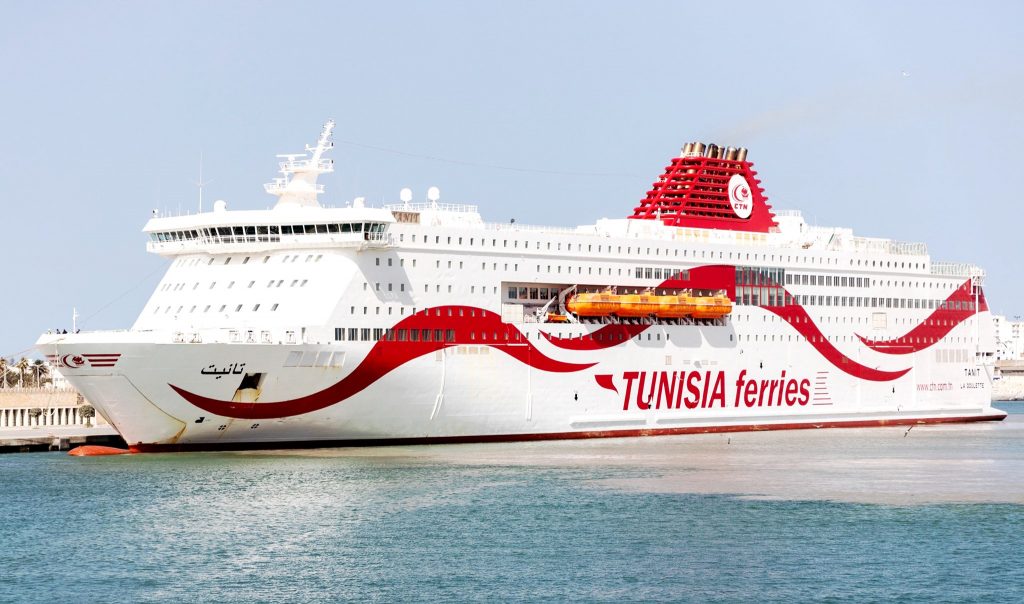
Most visitors fly, but Tunisia has long maritime and land connections worth knowing. Ferries run year-round from southern Europe to the port of Tunis (at La Goulette, about ten kilometres from the city centre), with a second seasonal gateway at Zarzis in the south. On the French routes, the operators are CTN — the national Compagnie Tunisienne de Navigation, often branded Cotunav — and Corsica Linea, sailing from Marseille in roughly 22 to 24 hours. From Italy, GNV (Grandi Navi Veloci) and Grimaldi Lines connect Genoa, Civitavecchia, Salerno, and Palermo; the Palermo–Tunis crossing is the fastest at around ten to twelve hours. Ferries make sense if you want to bring your own car or motorbike, or simply prefer the romance of arriving by water — book well ahead for the busy summer sailings, when families travelling with vehicles fill the boats.
Overland, the practical border is with Algeria, and there are now direct international bus routes between the two countries for the first time. The Libyan border, by contrast, is not a casual crossing; check current advice before considering it, and read our broader notes on whether Tunisia is safe to visit for the regions to approach with care.
The Louage: Tunisia’s Real Transport Network
If you learn one Tunisian transport word, make it louage. These are the shared minibuses (eight or nine seats) that form the true circulatory system of the country, linking every town and city far more frequently than any timetable could. They gather at dedicated stations, fill seat by seat, and leave the moment the last one is taken — no schedule, no waiting for a clock, just a steady all-day pulse of departures. They’re remarkably cheap, often faster than the train, and the fastest way to find yourself mid-conversation with a Tunisian grandmother who has decided you are now her responsibility.
A quick code to read them: louages with a red stripe run between governorates (the long-distance ones you’ll use most), blue serve a region, and yellow stay within a single governorate. Fares are fixed and posted; you pay the driver. For solo travelers and women in particular, they’re a perfectly normal way to move — sit where you’re comfortable, and a few words of Tunisian Arabic will smooth the whole exchange.
Trains: Slow, Scenic, and Worth It
Tunisia’s railway, run by SNCFT, is not the way to move fast, but on the right route it’s the way to move well. The spine runs north to south — Tunis down through Sousse, Sfax, and on toward Gabès — and on the busier segments it’s comfortable and inexpensive, with first-class carriages worth the small premium in summer. Along the Sahel coast, a handy commuter metro line links Sousse, Monastir, and Mahdia, threading the resort towns together without a car.
Two rail journeys are destinations in themselves. After an eight-year hiatus, the Tozeur–Tunis line has resumed service, reconnecting the capital to the gateway of the southwest oases. And the legendary Lézard Rouge, or Red Lizard train — a restored beylical train — runs a spectacular tourist route through the Selja gorges near Metlaoui, one of the great scenic rides in North Africa. Neither is about efficiency; both are about the going.
Intercity Buses
For routes the train doesn’t serve well, buses fill the gap. The national company, SNTRI, runs long-distance coaches from Tunis to most major towns, typically modern and air-conditioned, with the southern routes often departing in the cooler evening hours. Regional bus companies (the SRTs) handle shorter hops. Buses are a touch slower and less frequent than louages but more comfortable over long distances, and they keep to an actual schedule — useful when you want to plan rather than improvise.
Getting Around the Cities
Within Tunis, the workhorse is the métro léger — a tram network, despite the name, not an underground — which covers the capital cheaply if not always quickly. The separate TGM light-rail line is the one travelers love: it runs from Tunis Marine out along the coast to La Goulette, Carthage, Sidi Bou Said, and La Marsa, turning the northern suburbs into an easy half-day of hopping on and off.
Taxis are everywhere, painted yellow, cheap, and metered — the one rule is to insist gently on the meter (“compteur, aychek”) rather than agree a price. In greater Tunis, ride-hailing apps (Bolt and inDrive are the common ones; there’s no Uber) take the haggling out of it entirely, which many travelers prefer after dark. Outside the cities, a “grand taxi” is a shared long-distance car that works much like a louage.
Domestic Flights

Tunisia is compact enough that you rarely need to fly internally, with one real exception: the deep south. Tunisair Express operates short domestic hops, most usefully Tunis to Djerba and Tunis to Tozeur, which can save you a long day’s drive to the desert and the oases. For everywhere else, the road or rail is simpler than getting to and from airports.
Renting a Car and Driving Yourself
A rental car is the key that unlocks the parts of Tunisia public transport reaches slowly — Cap Bon’s back roads, the mountain forests of the northwest, the desert pistes of the south. Both international chains and local agencies operate at the airports and in the cities; bring an International Driving Permit alongside your licence, and read the rental terms on insurance excess carefully.
Then prepare yourself, because driving here is its own discipline. Fuel is cheap by European standards and the main roads are good, but the style is assertive, lane discipline is aspirational, and the unwritten rules take a day to absorb. Before you take the wheel, our field notes on Tunisian road habits will save you a few grey hairs at the first roundabout.
The Practical Layer
A few things that apply to every mode. Tunisia runs largely on cash, and the dinar is a closed currency you can’t obtain until you arrive, so keep small notes on hand for louages, taxis, and bus fares — our guide to the Tunisian dinar explains how the money works. A local SIM or eSIM is the single best purchase on arrival: maps, ride-hailing, and louage-station locations all live on your phone. And timing shapes everything — the best months to travel Tunisia are the mild shoulder seasons, when the heat won’t punish a long louage ride and daylight stretches your travel days.
The Bottom Line
For getting around Tunisia, the simple hierarchy is this: louages for speed and frequency between towns, trains when the route is scenic or the distance long and you’re not in a hurry, buses when you want a fixed schedule, taxis and ride-hailing within cities, a rental car for the back roads and the south, and a domestic flight only to skip the long haul to Djerba or Tozeur. Master the louage and the rest is detail. Tunisia is small, the going is cheap, and half the trip happens in the seat next to you.
From the Carthage Magazine Bookshelf
Working out the louage stations, the train timetables, and the right fare in a new country is exactly the kind of thing that’s easier with the answers already in your pocket. Three Carthage Magazine ebooks were built for the road:
- All About Tunisia — the definitive English-language traveler’s guide. 572 pages, 27 chapters, all nine regions, every UNESCO inscription, five thematic trails — and the practical answers (visa, currency, transport, etiquette) most travelers wish they’d had on the plane. $24.99 · PDF & EPUB
- Speak Like a Local — 200+ Tunisian Arabic phrases with native audio recorded in Tunis. The phrases for the taxi, the souk, the café, and the dinner table. $14.99 · PDF, EPUB, MP3
- The Authentic Tunisian Cookbook — sixty traditional recipes from the heart of North Africa. For when you get home and find yourself missing the food. $9.99 · PDF & EPUB
All three available as a bundle for $39.99 — guide, language, and food, delivered together.
