

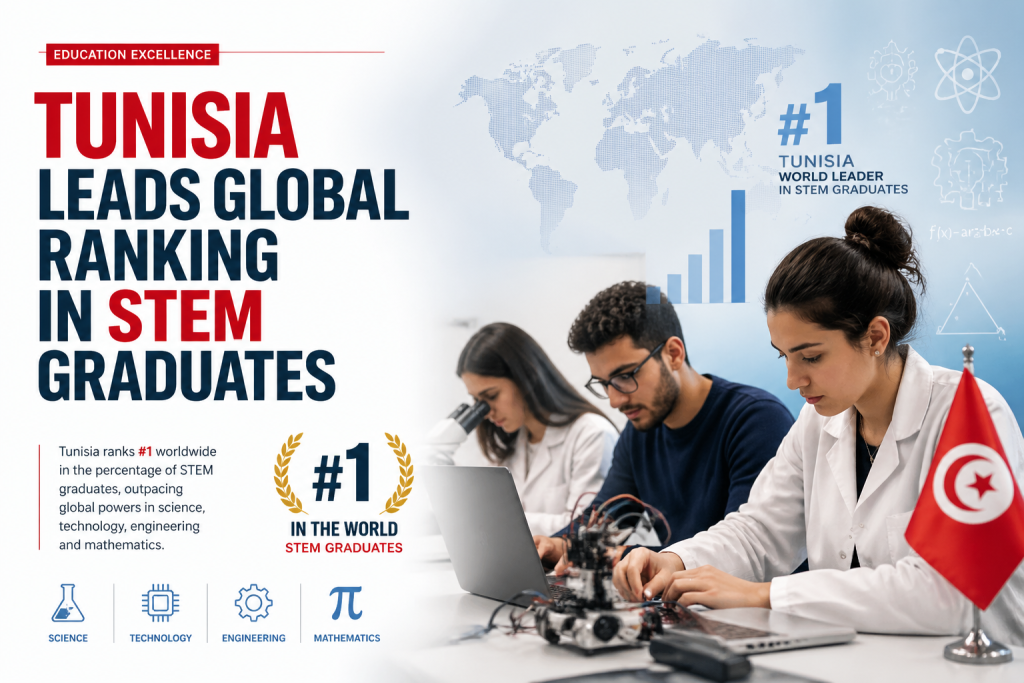
A recent report based on the latest data for 2025 has ranked the top 10 countries globally in terms of STEM (Science, Technology, Engineering, and Mathematics) graduates per 100,000 population. The list, compiled by the UNESCO Institute for Statistics (UIS) and the OECD’s Education at a Glance 2024, offers a glimpse into the countries that are producing the highest number of skilled professionals in the critical fields of STEM.
Leading the charge is Tunisia, which tops the list with an impressive 950 STEM graduates per 100,000 people. The country’s commitment to strengthening its education system and fostering innovation in STEM fields appears to be paying off. Tunisia is followed closely by Iran, with 890 STEM graduates per 100,000 people, marking a significant advancement in its educational priorities over the years.
South Korea stands at third place with 780 STEM graduates per 100,000 population, a testament to its robust technological and engineering infrastructure. The East Asian nation has long been a leader in technological innovation, and its universities are renowned for their emphasis on producing graduates who excel in these fields.
Germany holds the fourth spot with 610 graduates per 100,000, reinforcing its reputation as a hub for engineering and technical expertise, driven by both its historical strengths in manufacturing and its continued investments in research and development.
France ranks fifth with 580 STEM graduates per 100,000, a figure that reflects the country’s ongoing efforts to stay competitive in the global knowledge economy.
In sixth place is the United Kingdom, with 560 graduates per 100,000. While the UK is home to some of the world’s top universities and research institutions, the data indicates that other nations are catching up in terms of producing highly educated professionals.
Poland, with 540 STEM graduates per 100,000 people, comes in seventh, showing strong performance in the European context. Turkey follows closely in eighth with 520 graduates, signaling its growing focus on STEM education as a part of broader economic development goals.
Russia takes the ninth position with 510 graduates, a figure that highlights the country’s ongoing strides in expanding its technical workforce. Lastly, Spain rounds out the top 10 with 480 graduates per 100,000 population, underlining its efforts to boost STEM skills to support a diverse economy.
The report provides a comprehensive picture of global STEM education and the varying levels of emphasis placed on these crucial fields worldwide. As technology continues to shape industries, economies, and societies, countries with high numbers of STEM graduates are well-positioned to lead in innovation and economic development.
Source: UNESCO Institute for Statistics (UIS) – Education Database, OECD – Education at a Glance 2024
