
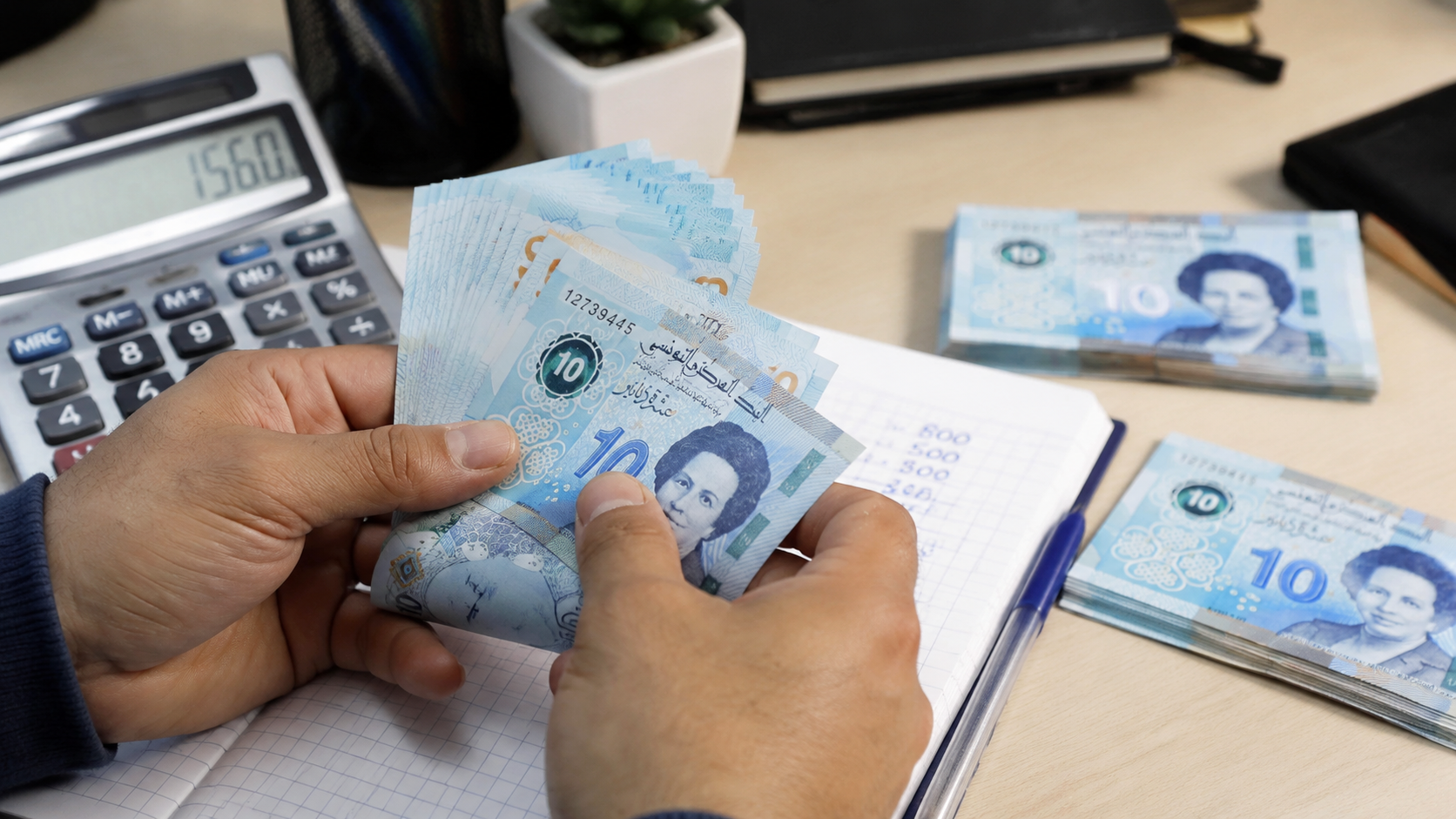
Tunisia has crossed a symbolic economic milestone: the value of banknotes and coins in circulation has exceeded 30 billion Tunisian dinars for the first time. According to Central Bank of Tunisia (BCT) data, cash in circulation reached 30.04 billion dinars on 21 August 2026 — roughly $10.4 billion — compared with 25.9 billion dinars on the same date a year earlier. That’s an increase of more than 4.1 billion dinars, or about 16%, in just twelve months.
The figure immediately raises questions. Is Tunisia becoming increasingly dependent on cash? Does this reflect a growing informal economy? Or is it simply the result of economic habits, uncertainty, and a slow transition toward digital payments?
The answer is more complex than a single number.
A Record Level of Cash — But Not a Richer Economy
The first point to clarify is that 30 billion dinars in circulation does not mean Tunisians have become wealthier by 30 billion dinars. Cash in circulation measures the physical money available for transactions and savings outside the banking system. It is a measure of liquidity, not a measure of national wealth.
A rise in cash usage can happen for several reasons: inflation, population growth, seasonal economic activity, changes in payment habits, or a preference for holding physical money rather than keeping funds in bank accounts. The BCT itself points to the calendar: the record was set at the tail end of a summer that stacked holiday spending, the tourist season, and back-to-school preparations on top of each other — the periods that reliably pull cash out of the banks every year.
What seasonality cannot explain, however, is the trajectory. The 20-billion-dinar bar was only crossed for the first time at the end of 2023. The stock stood at about 22.6 billion at the end of 2024, then 26.9 billion at the end of 2025 — and the pace is accelerating, with annual growth jumping from roughly 8% to 19% between those two years. Zoom out further and the picture sharpens: the amount of cash circulating in Tunisia has multiplied roughly fivefold in sixteen years.
16% of GDP — a Ratio That Stands Out
One comparison puts the milestone in perspective better than any headline. Cash in circulation now represents around 16% of Tunisia’s GDP, up from about 9% in 2010. In developed economies, that ratio typically sits between 3% and 4%. By this measure, Tunisia isn’t just a country that uses cash — it is one of the most cash-intensive economies of its size anywhere on the Mediterranean.
A Question of Trust in the Financial System
Cash remains deeply rooted in everyday economic life in Tunisia — a reality any visitor discovers within a day, and one our guide to the Tunisian dinar prepares travelers for. For many households and businesses, physical money is simple, immediate, and reliable. A cash payment does not depend on a banking application, a card terminal, internet access, or a financial institution.
This preference is also linked to trust. While digital payment systems have expanded, many Tunisians still perceive cash as safer and more under their control. Concerns about banking procedures, transaction fees, technical problems, and administrative complexity continue to influence payment choices. Inflation plays its quiet part too: even as the headline rate has eased considerably from its 2023 peak, years of rising prices mean the same everyday basket simply requires more banknotes than it used to — so withdrawals grow mechanically, even when habits don’t change at all.
The result is a paradox: while the global economy moves toward more digital and traceable transactions, Tunisia continues to rely ever more heavily on banknotes.
The Impact on Banks and Credit
A greater reliance on cash creates challenges for the banking sector. When money remains outside bank accounts, banks have fewer deposits available to support lending activities.
This does not mean that every dinar withdrawn from a bank disappears from the economy. Cash continues to circulate and support consumption. But a banking system with fewer available deposits may face more difficulty financing businesses and households through credit.
At a time when Tunisian companies frequently cite access to financing as a major challenge, the relationship between cash usage and bank liquidity deserves close attention — and gives the 30-billion figure a weight beyond symbolism.
Does More Cash Mean a Larger Informal Economy?
This is where the debate requires caution.
Cash transactions are harder to monitor than digital payments. They can make tax collection more difficult and may facilitate undeclared economic activity. Tunisia already has a significant informal sector, making the issue particularly sensitive.
But the existence of more cash does not automatically prove that all of it belongs to the informal economy. Many entirely legitimate activities still run on cash: small retailers, independent workers, household transactions, the market, the louage, the café. Anyone who has priced out daily life here — as our cost of living guide does — knows how much of the ordinary Tunisian economy legitimately changes hands in banknotes.
The increase in cash circulation should therefore be read as a warning indicator, not as direct evidence of economic informality.
The Cheque Reform, E-Invoicing, and the Acceleration of Cash
Recent policy changes have also shaped payment behavior. The stricter rules governing cheques, in force since February 2025, pushed individuals and companies to look for alternative payment methods — and BCT clearing data for the first half of 2026 confirms the shift: the cheque is the only major payment instrument declining in both number and value. In many cases, the alternative has been cash.
A newer obligation of electronic invoicing for certain businesses has added its own ripple, changing how some transactions are structured and settled. But neither reform alone explains the trend. The deeper issue is structural: Tunisia has not yet built a widespread culture of digital payment capable of fully replacing the traditional methods it is tightening.
The Challenge of Building a Digital Payment Economy
Moving away from cash requires more than introducing new technologies. It requires confidence.
Consumers need payment systems that are simple, accessible, and reliable. Businesses need reasonable costs and practical solutions. Financial institutions need to improve user experience and strengthen public trust.
Digital payments are not only about convenience. They also contribute to transparency, financial inclusion, and a better understanding of economic activity.
For Tunisia, the challenge is not to eliminate cash — cash will remain part of any economy. The challenge is to create a balanced system where digital payments become a natural choice rather than an obligation.
A Number That Deserves Attention
The 30-billion-dinar milestone should not be interpreted as proof of economic failure or of hidden wealth. It is a signal — one that reveals how Tunisians interact with money, institutions, and uncertainty.
Behind the record figure lies a broader conversation about trust, modernization, and the future of Tunisia’s financial system.
The question is not simply: “Why is there so much cash?”
The more important question is: “What would make Tunisians choose digital money over physical money?”
The answer will depend not only on technology, but on confidence in the economic system itself.
Figures in this article are based on Central Bank of Tunisia monetary indicators as of 21 August 2026.
