
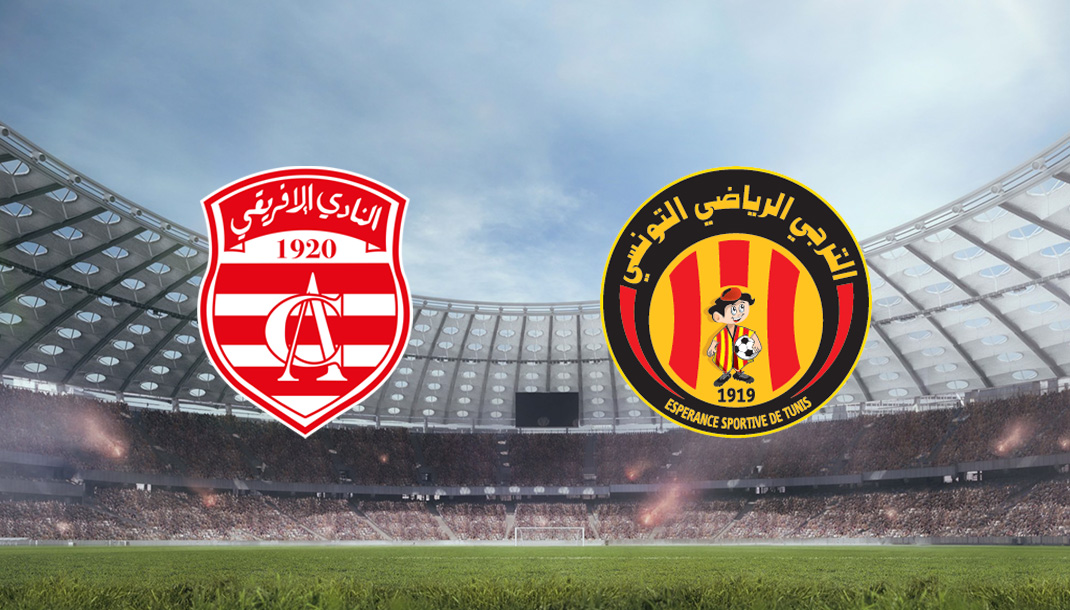
For most of the world, Tunisian football means the national team — the Eagles of Carthage, the red jersey, the World Cup heartbreaks and the famous wins. But ask a Tunisian which team they actually live and die for, week in and week out, and the answer almost never involves the national side. It involves a club — and, more often than not, one of two clubs from the capital whose rivalry has divided families, neighbourhoods, and the entire country for a hundred years. To understand how Tunisians really feel about football, you have to understand the Tunis derby: Espérance de Tunis against Club Africain, blood-and-gold against red-and-white. It is the loudest argument in the country, and it never ends.
We’ve covered the national obsession with the game before. This is the club rivalry at its heart.
Espérance: The Beast of Africa
Espérance Sportive de Tunis — Taraji, the “Sang et Or” (Blood and Gold) — was founded on 15 January 1919 in a café in the Bab Souika quarter of the Tunis medina. Over the following century it became, simply, the most successful club Tunisia has ever produced, and one of the most decorated in all of Africa. The trophy cabinet is almost comic in its weight: a record 34 Tunisian league titles, the most recent in 2024–25; a record number of Tunisian Cups; and — the achievement that earned the nickname “the Beast of Africa” — four CAF Champions League crowns, in 1994, 2011, 2018, and 2019. Espérance has carried Tunisian football onto the continental and world stage, competing at the FIFA Club World Cup and drawing a fan base that stretches well beyond the capital into a genuine national, and diaspora, following.
Club Africain: The People’s Club
Across the city stands Club Africain — the Clubistes, in their unmistakable red-and-white vertical stripes — founded on 4 October 1920. If Espérance owns the record books of the modern era, Club Africain owns a set of historic firsts that its supporters will never let anyone forget. It was the first Tunisian club to win an international trophy, the Maghreb Cup Winners’ Cup in 1971, and the first Tunisian club ever to win the African Champions League, in 1991 — a continental breakthrough that came years before its great rival’s. With 13 league titles of its own and a vast, fervently loyal support, Club Africain is a true heavyweight, and a multi-sport institution whose handball and basketball sections are among the best in the country. Recent seasons have been leaner on the pitch, but the size of the club and the devotion of its fans have never been in question.
The Derby That Stops the Country
The two have been playing each other since 1924 — the very first derby, fittingly contentious, went to Club Africain 3–0 — and they have now met more than 130 times. The fixture is held at the Stade Hammadi Agrebi in Radès, the national stadium on the southern edge of Tunis, whose 60,000-plus capacity is needed to hold the crowds the derby draws. On derby day the city splits in two. Flags hang from balconies, café arguments turn serious, and the ultras — the organised supporter groups whose choreographed tifos, flares, and chants are a spectacle in their own right — turn the stands into walls of colour and noise. Espérance hold the historical edge in the head-to-head, a fact their fans deploy freely; Club Africain fans counter with those continental firsts. Neither side has ever conceded the argument, which is precisely why it endures.
It is worth being honest that the rivalry has a harder side. Like big derbies the world over, the Tunis derby has at times been marred by crowd trouble and clashes, and matches have occasionally been played behind closed doors or moved as a result. The passion that makes the fixture extraordinary is the same passion that, on its worst days, spills over.
The League Behind the Giants
The two Tunis clubs dominate the conversation, but they don’t have the Tunisian Ligue Professionnelle 1 entirely to themselves. The most important challenger sits down the coast in Sousse: Étoile du Sahel, itself a CAF Champions League winner (2007), whose meetings with Espérance are billed as the “Tunisian Classico.” In Sfax, CS Sfaxien has its own proud continental record, with multiple CAF Confederation Cup titles. Together these clubs make Tunisia one of the genuine powerhouses of African club football — a small country that has repeatedly punched far above its weight on the continent, and whose academies feed the national team and export talent to Europe. The midfielder Hannibal Mejbri is one of many to follow that path from Tunisian roots to the European game.
Going to a Match
For a visitor, a league game — and a derby above all — is one of the most vivid windows into Tunisian life you can buy a ticket for. The football is competitive and the continental nights can be electric, but the real show is in the stands: the drumming, the banners, the call-and-response chants that don’t stop for ninety minutes. If you’re in Tunis when the calendar throws up a big fixture at Radès, go — sit with the home crowd, learn a chant, and you’ll understand more about the country in two hours than a week of sightseeing could teach you. Just pick your colours carefully, and maybe keep your allegiance quiet until you know which end you’re standing in.
It’s a reminder that sporting pride in Tunisia runs deep and wide — from the terraces of Radès to the tennis courts where Ons Jabeur carried the whole country’s hopes. The Eagles of Carthage may be the face the world sees. The clubs are the heartbeat underneath.
From the Carthage Magazine Bookshelf
If you want to understand Tunisia beyond the scoreline — the country that produces all this passion — three Carthage Magazine ebooks are the place to start:
- All About Tunisia — the definitive English-language traveler’s guide. 572 pages, 27 chapters, all nine regions, five thematic trails, and the practical answers most travelers wish they’d had on the plane. $24.99 · PDF & EPUB
- Speak Like a Local — 200+ Tunisian Arabic phrases with native audio recorded in Tunis — including, yes, the ones you’ll hear in the stands. $14.99 · PDF, EPUB, MP3
- The Authentic Tunisian Cookbook — sixty traditional recipes from the heart of North Africa, for the long lunch before kickoff. $9.99 · PDF & EPUB
All three available as a bundle for $39.99 — guide, language, and food, delivered together.
