
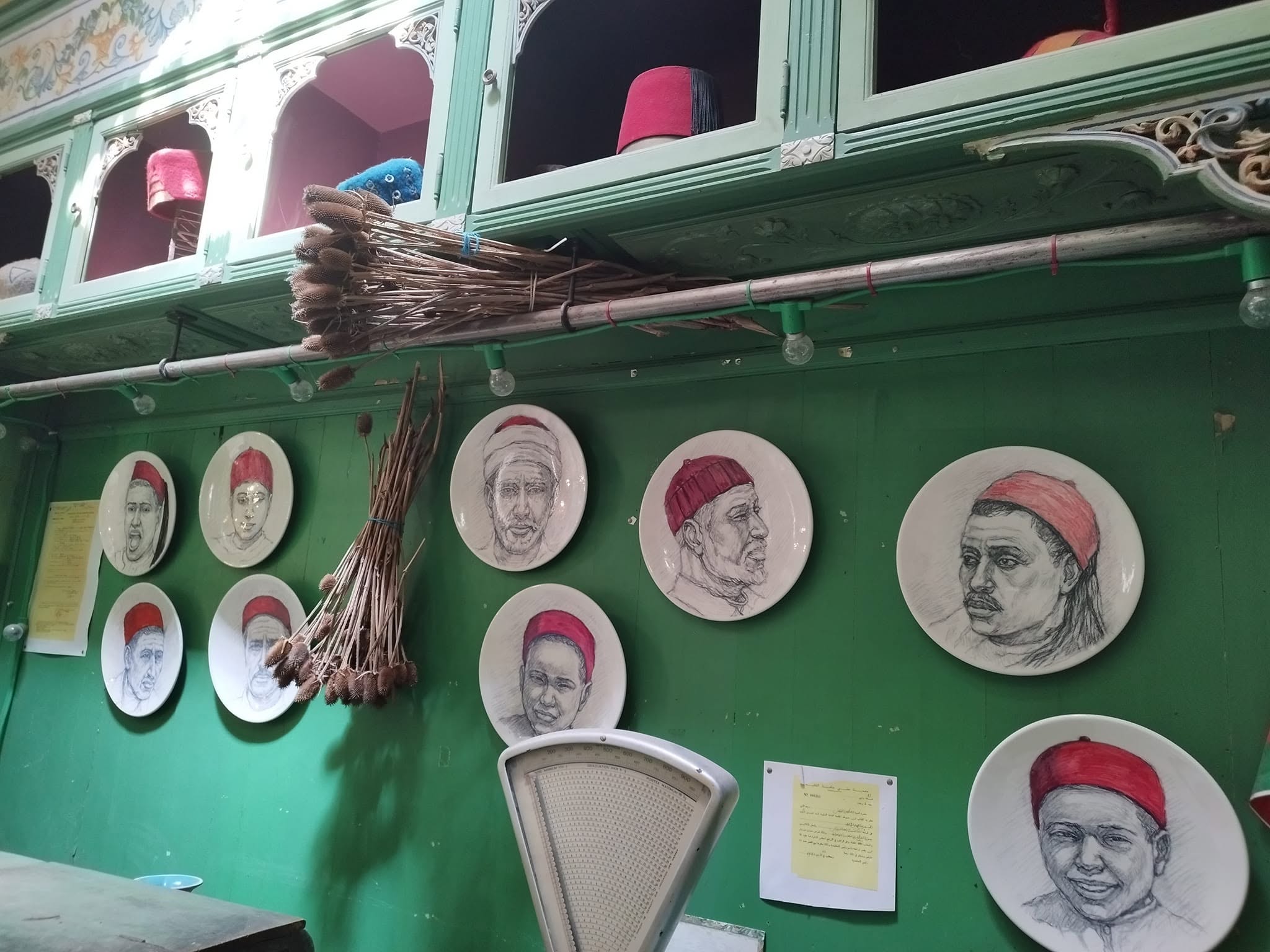
In a stone-vaulted alley of the Tunis medina, between the Kasbah and the great Zitouna Mosque, a man in a worn apron sits in a shop barely three metres across, surrounded floor to ceiling with boxes of small red caps. He picks one up, turns it in the light, brushes its surface, checks the stitch of a tiny logo sewn inside, and sets it on a pile. He is a chaouachi, a maker of chechias, and he is practising a craft that once employed tens of thousands of people in this exact quarter and made Tunisia famous from Cairo to Kano. The little vermilion hat in his hand has, by the time it reaches him, travelled further across Tunisia than most Tunisians ever will. This is the story of that journey, and of the most quietly iconic object the country produces.
We’ve written about Tunisia’s sefseri and its traditional costumes. The chechia deserves its own chapter.
A Hat With a Long Memory
The chechia is a soft, brimless cap of felted wool, dyed a deep vermilion red — the national headgear of Tunisia, and a close cousin of the European beret. It should not be confused with the rigid, conical fez (which Tunisians call the chéchia stambouli, the Istanbul cap); the chechia is lower, softer, and more pliable. Its lineage is long and much-debated — traced variously to Central Asia, to medieval Kairouan, and most persuasively to the Andalusian Muslims who fled Spain in the early seventeenth century and brought their felting expertise to North Africa. What’s certain is that by the late 1600s the craft had taken root in Tunis: the Souk Ech-Chaouachine, the chechia-makers’ market, was built in the medina around 1691, and under the patronage of the beys the trade boomed into one of the Regency’s great export industries. For a time, the little red cap was among Tunisia’s most valuable goods.
It carried political weight, too. In the 1920s, nationalists took to wearing the flat chechia testouriya — the style from Testour — partly because its name echoed that of their independence party, the Destour. Habib Bourguiba, the country’s first president, wore one. To put on a chechia was, for a while, to make a statement about being Tunisian.
A Craft That Crosses the Whole Country
Here is the detail that surprises even many Tunisians: no single person makes a chechia, and no single place does either. A finished cap is the product of a relay that runs the length of the country, each stage handled by specialists who do only their part.
It begins with wool — often spun in Djerba or Gafsa — which is distributed to women who knit it, by hand and from home, into a large white cap called a kabbous. These knitters, the kabbasat, work in Ariana and the rural towns around Bizerte; a skilled one might finish only a handful a day. The white caps are then sewn with each chaouachi’s unique maker’s mark and sent to El Battan, a felting works on the Medjerda river dating to around 1901 — the only wool-fulling factory of its kind in Tunisia — where they are soaked, beaten, and shrunk until the knitted stitches vanish and the wool becomes dense felt. From there the caps are carded with teasel thistle to raise a soft, velvety nap, shaped over moulds, and — most famously — dyed their brilliant red, a stage long associated with the town of Zaghouan. Only then do they return to the medina for the chaouachi’s final inspection and finishing. Start to finish, a single chechia can take four to five months to make.
It is, in other words, a piece of national infrastructure disguised as a hat — a craft that ties Djerba to Ariana to Bizerte to Zaghouan to the Tunis medina, sustained by thousands of pairs of hands.
The Honest Part: A Trade Holding On
There’s no avoiding the present tense. The chechia industry is a shadow of what it was. Where the Souk Ech-Chaouachine once held thousands of makers, today only a handful of workshops remain, most run by older men who learned the craft from their fathers and grandfathers and struggle to interest the next generation. Daily wear has faded — the cap now belongs mostly to holidays, weddings, and elderly heads — and cheap industrial imitations, dismissed by the chaouachis as mere “carpets,” undercut the real thing. The great majority of genuine Tunisian chechias are now exported, chiefly to Algeria, Libya, Niger, and Nigeria (where they’re often dyed black rather than red), which means the country’s own signature object survives largely on foreign demand. The El Battan felting works, a century old and prone to flooding when the Medjerda rises, has long awaited the restoration its importance deserves.
And yet the know-how persists, because no other country has matched it. Every true boiled-wool chechia worn across a wide stretch of Africa is still made in Tunisia, on the strength of skills accumulated over centuries. It is, as one maker put it, an underrated national success story — fragile, but not yet finished.
Seeing It — and Buying One
The place to encounter the craft is the Souk Ech-Chaouachine itself, in the heart of the Tunis medina, where you can watch chaouachis brushing and shaping caps in their tiny shops and step into the historic Café Ech-Chaouachine — one of the oldest cafés in the country — for a mint tea against a backdrop of malouf music. A real chechia is light, durable, genuinely useful, and steeped in all of the above, which makes it one of the most meaningful things you can carry home; our guide to what to buy in Tunisia ranks it among the country’s truest souvenirs. Buy it from a chaouachi in the souk, look for the maker’s mark stitched inside, and you’ll be holding the end of a five-month, country-long journey — and helping to keep it going.
For the wider walk through the old city that surrounds the souk, our honest guide to Tunis sets the scene.
From the Carthage Magazine Bookshelf
If the crafts and the medina are what draw you to Tunisia, three Carthage Magazine ebooks were built to deepen the visit:
- All About Tunisia — the definitive English-language traveler’s guide. 572 pages, 27 chapters, all nine regions, five thematic trails, and the practical answers — including the souks worth your dinars — most travelers wish they’d had on the plane. $24.99 · PDF & EPUB
- Speak Like a Local — 200+ Tunisian Arabic phrases with native audio recorded in Tunis. The phrases for the souk, the haggle, and the café. $14.99 · PDF, EPUB, MP3
- The Authentic Tunisian Cookbook — sixty traditional recipes from the heart of North Africa, for when you’re home and missing the medina. $9.99 · PDF & EPUB
All three available as a bundle for $39.99 — guide, language, and food, delivered together.
