
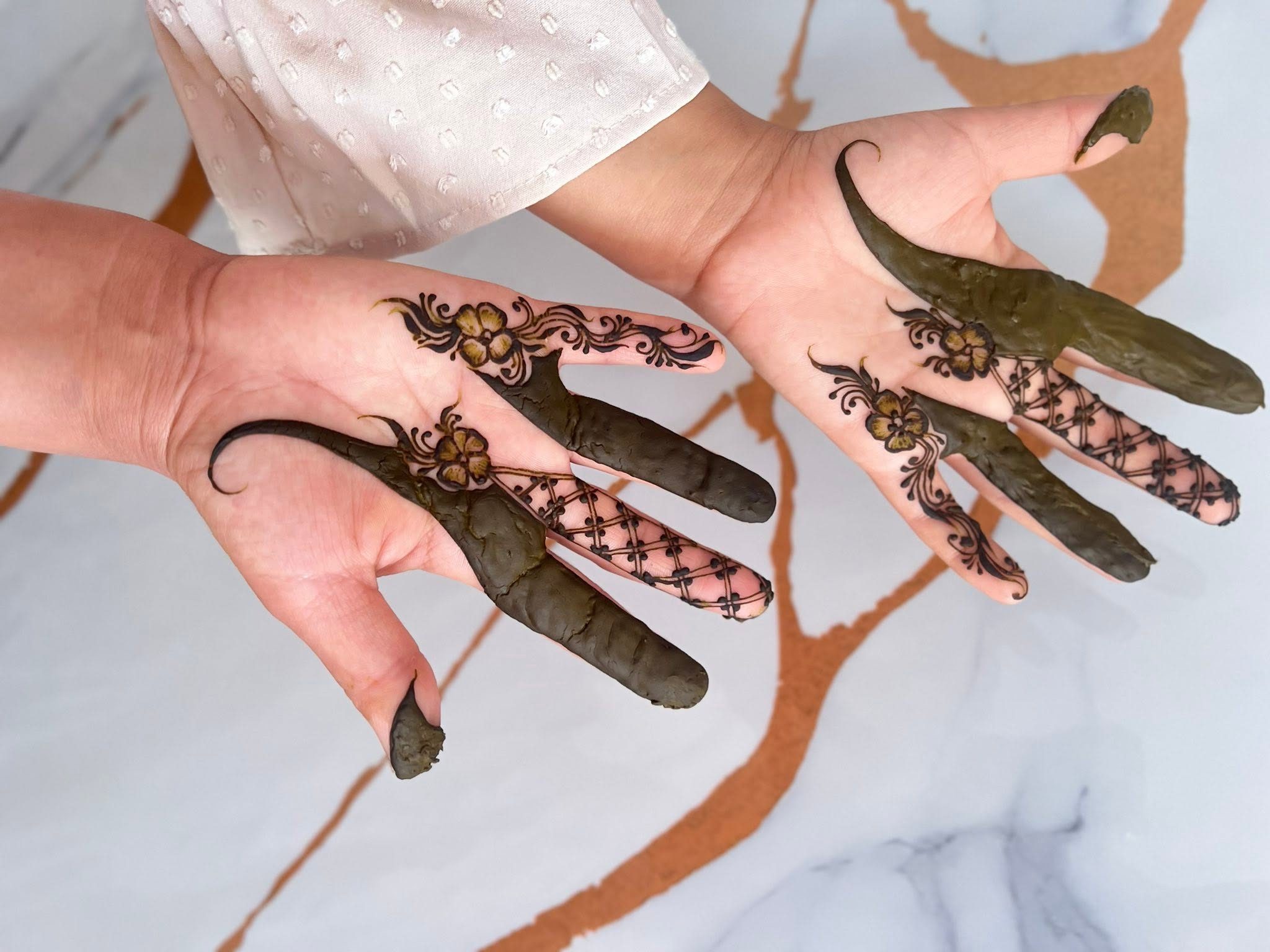
There is a moment at every Tunisian henna night when the room goes quiet. The bride is seated on a raised platform, hands open in her lap, and an older woman — the hannena — leans in with a cone of dark-green paste and begins to draw. A line, a curl, a blossom opening across the palm. Around them the songs keep going, the same ones sung at these gatherings for generations, and the women of both families press close to watch the pattern take shape. By morning the paste will have flaked away and left behind a deep red-brown stain that no scrubbing will lift for a week or two. That stain is the point. In Tunisia, henna is never only decoration. It is a mark that something has changed.
Most visitors meet henna at a wedding, and we’ve told that story in Inside a Tunisian Wedding. But henna touches far more of Tunisian life than the bridal week, and the plant behind it carries three thousand years of meaning. Here is the fuller picture.
The Plant Behind the Stain
Henna comes from Lawsonia inermis, a hardy flowering shrub that thrives in the hot south of the country, particularly around Gabès and the oases of the Djerid. Its leaves are dried, ground to a fine powder, and mixed with warm water — and sometimes lemon, tea, or a little sugar — into a paste that releases a natural dye called lawsone. Left on the skin for a few hours, it stains in tones that range from bright orange to deep mahogany, deepening over the first day or two before slowly fading. The same powder has been used for centuries to colour hair a glossy auburn and, in rural tradition, to cool and condition the skin against the desert sun. What began as something practical became, over time, something symbolic: a substance associated with baraka — blessing, good fortune, and protection.
The Henna Night: Tunisia’s Most Vivid Ceremony
Within the long arc of a Tunisian wedding, the henna night is the evening people remember. It follows the bride’s visit to the hammam, where female relatives accompany her for a ceremonial cleansing, and it unfolds as a women’s celebration — loud, warm, and dense with ritual. The bride often wears a fouta wa blouza, the striped silk dress of the coast, or one of the regional gowns described in our piece on Tunisia’s traditional costumes. The hannena applies the paste to her palms and the soles of her feet in patterns that can take hours, while the guests sing and the tea and sweets circulate well past midnight.
The meaning layered into those patterns is specific. The henna is meant to bring good fortune into the marriage, to mark the bride visibly as a woman crossing into a new life, and — importantly — to ward off the evil eye, the envious glance that Tunisian tradition treats as a genuine hazard at moments of visible happiness. It is no accident that henna and the Khomsa, the five-fingered hand of protection, belong to the same symbolic world. Unmarried guests will sometimes ask for a dab of henna of their own, in the same spirit as catching a bouquet: a small wager on their own luck. The groom, in many regions, receives a single dot in the centre of his palm.
Harqous: The Black Lacework
The night after the henna, in many traditional weddings, comes the harqous. Where henna stains red-brown, harqous is a black paste — historically built from ingredients like soot, charcoal, and aromatic resins — used to draw finer, more graphic designs: trailing vines, birds, geometric borders that frame the henna beneath. The two are often confused by outsiders, but Tunisians keep them distinct. Henna is the warm, blessing-bearing base; harqous is the crisp black line-work laid over and around it, the calligraphic flourish that turns a stained palm into something closer to embroidery.
Henna Beyond the Wedding
Reduce henna to weddings and you miss most of its life. It appears at the celebration that follows a boy’s circumcision, dabbed on small hands for protection and luck. It marks the two Eids and, in many families, Mouled, the Prophet’s birthday — occasions when grandmothers will quietly henna the children’s palms. It has long welcomed pilgrims home from Mecca, and in some rural communities it accompanied births and other thresholds. The thread running through all of these is consistent: henna marks the passages where a person is exposed — to change, to envy, to the unknown — and offers, in a smear of cool green paste, a gesture of protection and good wishes. It is the same instinct that hangs a Khomsa over a doorway, expressed in a form you wear on your skin.
A Map You Can Read by Region
Like so much in Tunisia, henna varies the moment you travel. On the coast and in the cities, henna nights have often been accompanied by soulamia — women’s ensembles singing Sufi-inflected hymns, a restrained and devotional register. In the south, the same evening turns to the darbuka drum and vigorous regional dances, with the bride sometimes dressed in vivid Amazigh-style gowns rather than coastal gold. The designs shift too: some regions favour bold, solid fields of colour on the fingertips and palm; others prefer the fine floral and geometric patterns that the hannena builds up over hours. None of it is standardised, which is exactly what makes it living tradition rather than performance.
A Word on “Black Henna”
One honest caution, because it matters. Natural henna is reddish-brown and entirely safe; it cannot stain jet-black. Any paste sold as instant “black henna” that develops a hard, very dark outline within minutes almost always contains added PPD (paraphenylenediamine), a synthetic hair-dye chemical that can cause severe skin reactions and lasting scarring, especially on children. Traditional harqous is a separate, time-honoured craft; the modern tourist-stall “black henna” is not the same thing. If you want henna while travelling in Tunisia, ask for natural henna, accept that it will be brown rather than black, and walk away from anything that promises a black stain in fifteen minutes.
Where to See It — and Where to Buy the Powder
The surest way to encounter henna is to be lucky enough to receive a wedding invitation; if you ever do, go. Short of that, the souks are the place. In the Tunis medina, the Souk el Attarine — the perfumers’ market — has sold the components of the bridal koffa, the beauty basket, for generations: henna powder, kohl, swak, incense, and rosewater, heaped on the same tables their grandfathers worked. Henna powder is cheap, light, and one of the more meaningful things you can carry home; our guide to what to buy in Tunisia places it among the country’s most authentic souvenirs. Buy it where Tunisian brides’ families buy it, and you’ll have the real thing.
From the Carthage Magazine Bookshelf
If Tunisia’s traditions — the henna night, the souk, the language of the table — are pulling you in, three Carthage Magazine ebooks were built to take you deeper:
- All About Tunisia — the definitive English-language traveler’s guide. 572 pages, 27 chapters, all nine regions, every UNESCO inscription, five thematic trails, and the practical answers most travelers wish they’d had on the plane. $24.99 · PDF & EPUB
- Speak Like a Local — 200+ Tunisian Arabic phrases with native audio recorded in Tunis, including the greetings and blessings you’ll hear at a henna night. $14.99 · PDF, EPUB, MP3
- The Authentic Tunisian Cookbook — sixty traditional recipes, including the sweets that circulate at every henna gathering. $9.99 · PDF & EPUB
All three available as a bundle for $39.99 — guide, language, and food, delivered together.
